
Somewhere
in Monterey
Nocturnes of Monterey County
Reflections on Paintings of the Night

Paintings by Joaquin Turner
Narrative by Charles Sheppard

Nocturne
Nocturne. A mysterious word. Exotic. It comes from the Latin nocturnus, meaning literally, “of the night.” For most of two hundred years it has referred to music which evokes the peaceful feelings nighttime brings us. Nocturne music is slow, atmospheric, haunting.
In modern times the term has become associated with other fine arts. Film noir or “dark film” thrills us with slow music, misty night scenes and moody themes. Dark-side literature gives us fabulous stories of magic, mystery and melancholy played out in the deep shadows of balmy autumn nights. Black-and-white photographs enthrall us with eerie moon-lit landscapes.
Paintings of the Night
The cool colors used in nocturne paintings impart a kind of subdued emotion, calming us—an assertion backed up by plenty of research. The muted light and dark corners bring mystery, creating space for our imaginations to fill. The effect is moody, balmy, and slow, like the music, like the best of film noir.
Nocturne paintings are easy on the eye. An exceptional night scene alters the perspective of a landscape, and affects the emotions of a viewer. If you sense happenings in those deep shadows, if you feel welcomed by the soft glow of candlelight through the window of an old adobe dwelling, then the nocturne you are experiencing has done its job.
There are few paintings more enticing than those depicting nocturnal Monterey County in its remote past. Turn the page, draw back the veil of time, pack up your imagination and come along as we explore “paintings of the night” and travel some of the imaginative byways they inspire.

Joaquin Turner
Old French Consulate
Oil on Canvas
Soft clouds turn the moon a corn tassel yellow...
yet the moon’s water image is a cold, cold white. What strange tricks Monterey’s atmosphere plays on our senses.
Darkness has come to the Old French Consulate, and within the mud-brick structure a lamp still burns: the French Consul remains at work. His efforts on this night probably involve entertaining which, after all, is much of what consuls do: communing with important people, gleaning truth from obfuscation, and conveying their own half-truths, all the while drinking fine wines and dining, in this case, on French cuisine.
The night is still and cool: look closely to see tendrils of smoke wafting from the chimney. The smoky-gray clouds above are dissolving in favor of incredibly sublime shades of blue and green. Subtle reflections from the coppery haze in the distance tint the eucalyptus canopies.
The moon is doing double duty tonight—our artist has given us two for the price of one.
Within the eucalyptus forest gray lichen grows thick on rotting logs. A fox hunts there, also gray. An exquisite Great Blue Heron—that majestic prehistoric-looking bird which is drawn to the area’s wetlands to survive on fish, frogs, turtles, snakes, rodents and even smaller birds—visited a short time ago, dropping soundlessly out of her nest to search out a meal in the estuary’s fading dusky light.
You may wonder how we can know these things. Well, our imaginations tell us, and you, dear reader, may imagine things we do not. Imagination gives us the freedom to go down pathways we do not contemplate traveling when we first seek out the night. A painting may speak to us, and if so, we will talk back. Together we will create dialog, memorable stories, and fine poems. We have only to believe the picture is alive, and our belief will start the process.
This painting evokes the mythic forest primeval. The calming water with its gentle ripples and soft reflections enhances the ancient spirit of the place.
We feel the stillness here. We appreciate the dark serenity. And we become aware that the painting is not only about the occupant of an adobe and fine wine and a water-reflected moon and a large bird hunting its supper—it is also about a feeling the artist has successfully conveyed to us, a calmness. The coolness, the darkness, the conveyance of emotion: these are characteristics of a fine nocturne painting.

Joaquin Turner
Sherman Quarters
Oil on Linen
"I had a small adobe-house back of Larkin's"
On this night around 1910, it looks almost exactly as it did when it appeared on this spot in 1834. It is by no means in the state of decline you may infer from the loss of surface material near window and door. It wants only a fresh coat of plaster—a preservation chore routinely required of all adobe structures. Its curved roof tiles of fired red clay are in good repair, as are the tiles covering the tops of the garden walls. These walls and those of the house, both built out of adobe bricks, would soon disintegrate without hard “burnt” tiles to shed Monterey’s hard rains.
This old place is modest, but not plain. Look at the softly luminous blue-green on the walls, colors which the moonlight has gathered from the environment, stirred up and spread onto the lime-plastered surfaces. Words alone cannot fairly describe these beautiful cool shades.
Watch as the moonlight dances on the oxblood red roof tiles (moons are obliged to labor hard in nocturne paintings). The soft shadow beneath the eaves captures an image of the jagged edge of the tile roof. The warmth of the yellows-ambers-reds through the window—does an oil lamp burn within?—is almost palpable.
Look for the sliver of red-orange light peeking out from beneath the door. What a clever embellishment that is. The door invites us to knock, the-teakettle-is-on-and-it-is-warm-and-snug-in-here.
The trees begin to enfold the house, protecting it. The soft ink-blue sky above is so deep it seems not to stop at the frame’s edge. This sky holds an intriguing astronomical flourish—our artist tells us it is the constellation Leo.
What lies back of these walls? A young field mouse, perhaps, lying peacefully amid the roots of the eucalyptus, nestled cozily in the bed she constructed of shells from the local acorns she seeks out as a primary food source.
A horse nickers, and we hear the fading clatter of hooves. Is it young Lieutenant William Tecumseh Sherman riding off to Bonifacio’s adobe, rose in hand to present to Bonifacio’s daughter Maria?
The silence is almost total now. Just the ever-present thrum of the sea whispering at the edge of our consciousness.

Joaquin Turner
Castro Adobe
Oil on Canvas
Castro's adobe is going to wrack and ruin.
Old and shabby, it sits on a scrubby rise a short distance from central Monterey. Pictured on a night in1890, it is one of the town’s few surviving century-old adobes, though it may not survive much longer: Monterey’s rain has found a way in.
The sea swallowed our old sun just moments ago.
The clouds had absorbed strong reds and purples and grays and merged them in brilliant combinations. The moment was majestic but short-lived—the clouds remake themselves so quickly here, and we all know that sunsets everywhere are fleeting things: a sudden flare of pale rose against rich amber-lit sky, fast turning to bright crimson and purple, softening to silver and finally darkening to blue-toned pewter.
Sunsets often figure prominently in nocturne paintings. The one above the Castro Adobe is now just a smudge of pale rose glowing on the horizon, only moments away from becoming a memory. Perhaps tomorrow will bring another.
The sky is awash with stars visible through tendrils of shredded cloud.
The soft amber in the early evening sky has given way to unimaginably exquisite blue-greens. Nightfall at the Castro place brought together atmospheric conditions which produce a phenomenon known as chemiluminescence, called more commonly (and romantically, and thankfully), “night-glow.”
Solar radiation and cosmic rays from deep space play a part. These interact with charged particles in the air miles high above us. Devise a complicated scientific formula, insert some phrases such as “visible part of the electromagnetic spectrum,” add a pinch of Monterey mist, and out come the softest of luminescent greens and violet-blues, and less often, pale yellows. Night-glow is rare, and like sunsets, fleeting. But you can see it here.

Joaquin Turner
Mission Church Courtyard,
Alta California
Oil on Linen
We Call the Living, We Mourn the Dead, We Drive the Demon
The California Mission builders fashioned a variety of architectural structures to support their mission bells. The pierced bell wall—campanario, in the language of the mission builders—was the most visually pleasing. This one dominates the courtyard at Mission San Juan Bautista.
This particular courtyard is the key refinement in the otherwise commonly designed mission exterior. White and glaring in the day, in the dusky-darkening hours it becomes an intimate nook offering cool seclusion and the opportunity for personal reflection.
This painting is a color-filled gemstone, an opal filled with bits of bright pale green and turquoise, not exactly crimson and not precisely rust, a mix of burgundies, and right-on plum. The brilliant courtyard walls seem to shimmer as these colors move toward us out of a midnight background of breathtaking blue indigo.
The subtly glowing mix of color on the left wall jutting toward bestows a striking impression. The red tones grab and hold us.
Run your hands over these walls, explore the rough textures time and weather have layered upon them, feel the stored day’s heat they will release slowly in the coming hours. Examine up close those impossible reddish tones which the moonlight has fashioned out of the red tiles, warm wood, deep purplish clouds above and mauvish foliage below.
These colors will fade as the moon falls, but the stars, shining silver-white, will remain with us through the night. Deepening darkness will give way to dawn, and there will follow another blistering day, and then another moon to spread its fleeting glimmer.
The painting is boldly composed, the structures well-placed within the frame. The contour of the structures climbs and curves and falls and encloses. It moves and our eyes must follow. The strong walls and the encroaching foliage add emphasis to the separation of sky from courtyard, and preserve the intimate feel of the closer space.
The gated wall to the right draws our attention, so artfully is it crafted. Its wooden door, set deep in shadow, beckons us to pass through: we know it leads to the cemetery and we dread the eerie spirits we will find there at this haunting time of night.
Turn again to the upper portion of the green-shimmer bell wall and focus on the three arched alcoves that shelter the sleeping mission bells in perpetual shade. A few brush strokes set against the apparent near-total darkness convey “bells” and their dormant power in a way that might be diminished with the addition of more detail. Turner knows if he offers just a tantalizing glimpse, our imaginations will do the rest.
Can you feel the strength in these bells, even in their half-hidden shadowy forms? They are silent tonight, but come morning they will drive the demon.
The painting stirs our gentler natures, asking us to speak softly, tread softly, and take time for reflection. In its muted palette, its glowing places, its darkened spaces, and the peaceful optimism it arouses in us, we experience the components of fine nocturne paintings.
Joaquin Turner
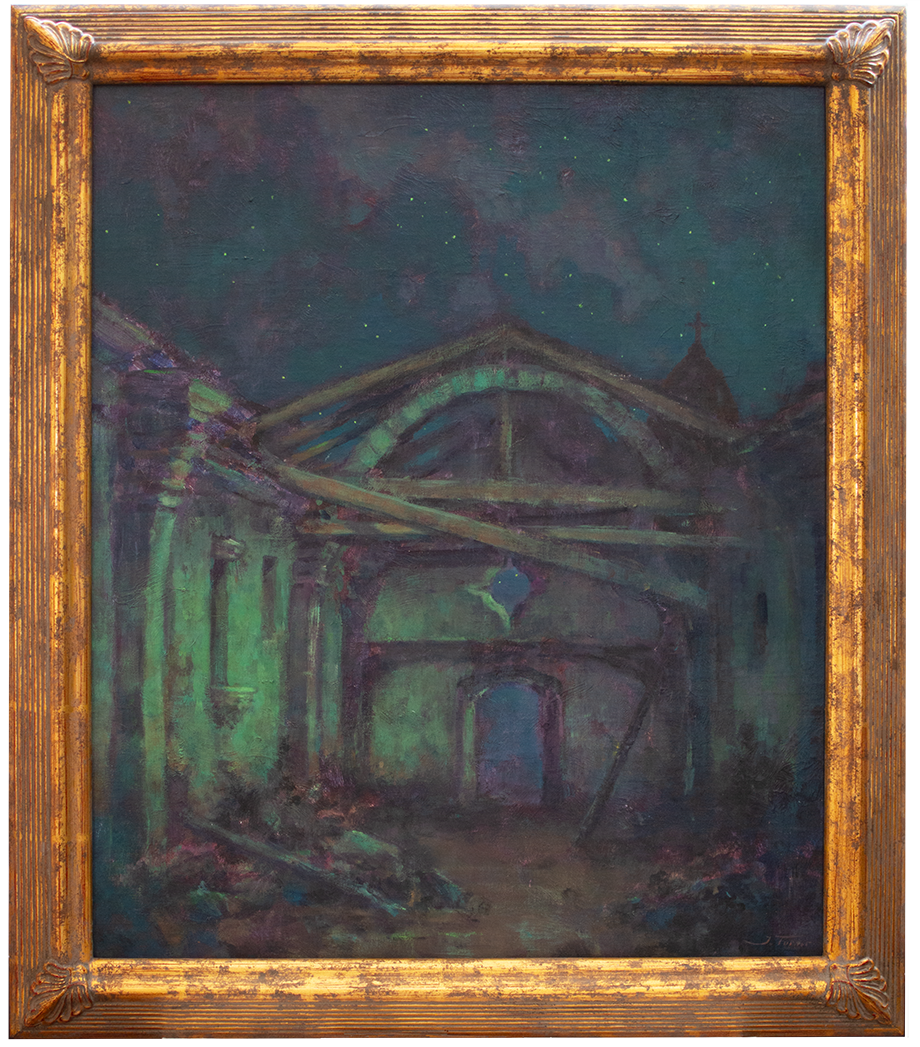
The Mission Church, Humbled
Oil on Linen
A late night some years before 1880.
We stand ankle-deep in the weeds where once stood an altar. This is the church of Mission San Carlos Borromeo del Rio Carmelo, in extremis. The once magnificent stone and mortar structure, one of the finest of the Spanish mission churches in Alta California, will soon reach its lowest state of wretchedness. Without a roof to shed the rain the rafters will continue to rot and fall, leaving only pieces of wall standing amid piles of rubble.
An errant vaquero rode in earlier this evening, right into these ruins. Perhaps drunk or perhaps not, with his pistol he shot up the place. To him it meant little that these well-crafted stone walls were once finely finished and hung with religious paintings and exquisite carved icons. The walls tonight are devoid of such ornamentation, cold and raw. Only fragments of the timber roof supports remain. The clay roof tiles and most of the timber has fallen, to be taken by the local populace for use in their houses—not stolen, exactly, for the church was abandoned four decades ago.
We do not see that old, cold moon here—it is behind us tonight, continuing its circuit west. But we see its effects: the almost indescribable green hues are growing even more luminous as they flow over the church walls and along the heavy stone arch above. The muted reds in the shadows compliment the greens everywhere, enlivening them. Yes, moons do indeed labor hard in nocturne paintings.
A star-strewn sky is visible through wispy clouds rimmed in purple hues. We see these things outside of the arched door and the pierced star window, through the decaying rafters, and directly above. The sky is deep blue toned with green—the rare night-glow phenomenon has returned.
Bodies are buried within these walls. One grave holds a long-forgotten Spanish governor and his wife and child, though mostly they are the many priest-protectors of the Mission who for forty years looked after the stone church and its devout local community. These walls can no longer protect their graves, but few would disturb them, for fear, perhaps, of stirring the ghostly presence. And who would want to? The dead were poor people for the most part, and took only their poverty with them.
A gray owl calls out from its dark shelter in the crumbling belfry. Small wild things look about them in terror. A rodent—a churchmouse, naturally—cowers at the sound, then sniffs in fearful curiosity. Rodents are largely nocturnal animals, as are owls. The churchmouse is wise to cower, knowing the old owl is wiser still.
The existence of this particular mission owl on this night in about 1875 was reported as fact. The emotions of the mouse must remain conjecture.
There is much to see and to wonder about here, but our vaquero, he cares nothing about any of it.

Point Joe
Joaquin Turner
Oil on Linen
“Point Joe has teeth and has torn ships; it has fierce and solitary beauty…”
So wrote Carmel’s Robinson Jeffers in “Point Joe,” the poem he named after an outcrop overlooking the Restless Sea.
This Restless Sea is an angry place about one league south of Point Pinos. It growls, and churns, and pounds. The waves converge from several directions, relentlessly breaking against rocks and each other. This constant turbulence may not seem all that treacherous when viewed from the refuge of dry land, but that impression is deceptive. The currents, the contour of the sea bottom, and Point Joe’s submerged granite teeth render the Restless Sea a deadly place for the maritime works of mere humans. A wooden ship trapped here stands little chance of survival.
“Restless” is the perfect word to describe this rugged, agitated place. On a late August night in 1906 it tore the life out of Celia.
SS Celia
The ship is the SS Celia, steaming toward her doom beneath a mesmerizing display of light and color such as we never expected to see anywhere. The mist is dense, the clouds are flying, the granite is stony-cold. By all rights we should dread the destruction about to unfold before our eyes. But dread is not the emotion we feel.
The irrepressible natural forces at work here absorb our imaginations. Tonight they will overwhelm all that comes before them. This thought comes to us, unbidden: the forces of nature always prevail. We are bound to respect their elemental power and their total indifference to human concerns. This painting gives us little choice. We must accept the inevitability of it all.
The serenity that follows acceptance—that is the emotion we feel.
Joaquin Turner’s understanding of sky-cloud-moon relationships, viewed through Monterey’s nocturnal atmospheric lens, is again on display. His portrayal of the midnight sky is sublime. A cloud-tunnel spreads incredibly subtle illumination to every shadowy-cold corner, transforming a portent of disaster into a hauntingly beautiful scene. He has captured the “fierce and solitary beauty” Jeffers observed a century ago.
Celia’s story is tragic. Her painting is irresistible.

Joaquin Turner
Pastures of Plenty
Oil on Linen
A farmstead tucked away in a fold of the Gabilan Range.
It is early evening in an autumn month.
The tall grasses and distant hills have turned a warm golden-brown. The inland county sky displays the cool, luminous blue-greens we have become accustomed to seeing in these paintings. The moonlight has suffused the landscape with soft shades of cyan, sparingly applied,
Delicate touches of rusty-reds complement and enhance the blues. The control of color in this painting is masterful. Every element contributes to a scene that whispers pastoral, and, nocturnal.
Were we to push our way through the tall grasses and approach the walls of the barn we would find there the heads of old nails embedded in dry cedar planks once painted red, but with no trace of paint remaining, the wood siding now several shades of weathered gray toned by reflected moonlight to a light blue. We would see black rust stains bleeding down from those nails, and from hinges and hasps.
A small, white mare resides here. She nickers in her sleep, just a soft whisper. We shall name her Whicker. She stands on the far side of the barn tonight, profiled against its pale siding, casting her dark gray moon-shadow onto the faded wood: a nocturne photograph waiting to be taken, a gelatin silver print to be made.
Do you recall Sherman’s young field mouse? Her distant relations reside here. They will be fewer by morning, though: the owls and the coyotes are out tonight.
We need not go near to see these and countless other small details. We imagine their existence beyond our view, and that is satisfaction enough. For now we are content to stand outside looking in, our emotions feeling the pull of the fields and the distant hills and the cold scattered clouds and colder moon.
The night is still and quiet, though we may hear the soughing of the wind and the kittering of the coyotes.
Star Window, mission church San Carlos Borromeo del Rio Carmel

The inside of a nocturne painting is a pleasant place to be.
The muted light, the dark places with diminished visual information, bring mystery, creating space for the imagination to fill.
Nocturne painters consciously limit their use of both color and light in order to give their paintings the characteristics often described as atmospheric, or mysterious. These characteristics impart states of mind we may identify as thoughtful, or serene, or nostalgic.
Soothing color and soft light tend to press their influences on us without our conscious thought. We don’t need to search for mood—it will find us. Look long at Turner’s paintings, and you will come away with an adjective which best suits yours. Nocturnes are, to a great extent, about mood.
We—the makers of this book—choose to write about nocturnes because they offer plenty of those dark shadows, and therefore, ample opportunity to engage with the paintings in imaginative and personal ways. How did we put it?
and Mood


Soft light and subdued color work hand-in-hand. On the palettes you see here the colors become muted, one palette following another, as they would during the time twilight rolls into various stages of darkness. By using the term “muted” we do not suggest nocturne paintings look faded in the sense of being dusty or dull—just look at the lustrous components of the paintings in this book. We mean only they are shades darker than their renderings would appear in full daylight. Stand for a while as the sun drops out of the sky and falls behind a mountain or the ocean’s horizon. Look at things all around you, and you will see their colors “tone down” in stages.
Look closely into the night, no matter how dark it becomes. You will find color even in its deepest recesses.
Light...
Peer into this abstract painting of an incomprehensible alternate universe…or is it a detail from a nocturne artist’s antique palette? Focus for a while on the preponderance of blues, greens, purples, deep violets and grays—in painters’ parlance, the “cool” colors. An abundance of science tells us these colors tend to calm us. As daylight wanes. our color perception shifts toward the blue-green part of the spectrum. It gets a bit complicated: let’s just say these are the colors our eyes can best make out as nighttime spreads its serenity over us.
Your eyes will soon be drawn to the small explosions of pink, bright mauve, white, and finally to the bits of deeper red tones. These “warm” colors tend to excite our emotions rather than calm them, so nocturne painters use them sparely, but use them they must: they know small dabs of complementary color enhance the preponderant cool tones.

Color...
Go in search of nocturnes, and you will find mood.
Historical Snippets
Monterey’s surviving old adobes had multiple owners and served many purposes, and the dwelling known popularly as the Old French Consulate is no exception. It has been many things, some notable and some lost to common memory. It was built as a residence in the early 1830s. In the early 1900s it was, for a time, a “tamale house,” a characterization we find most suitable in an adobe—a comforting old place from which the fragrance of seasoned meat and cornmeal dough would reach the locales, luring them out of Monterey’s chill to purchase the warm spicy corn-husk-wrapped things (for “take-out,” we suppose, or perhaps to enjoy on the spot).
It was not always situated where we see it here, perched on the edge of the estuary. In the 1930s the land it occupied was taken for other purposes, and it was dismantled, brick by massive brick, probably 5,000 of them, by calloused hands and ropy muscles, and reassembled on this spot. In this move-it-or-lose-it situation the preservation-wise city leaders chose the former option, thus saving one of Monterey’s most historically significant buildings.
This painting transports us back to earlier times. When we contemplate the distant adobe we like to imagine it in 1845, in its most romantic context as the home of the first French Consul to California.
Within the eucalyptus forest gray lichen grows thick on rotting logs. A fox hunts there, also gray.

Old French Consulate

William Tecumseh Sherman’s tour of duty in Monterey ended many years before he achieved national notoriety, yet we have adopted him as one of our own. The house in which he resided now bears the title “Sherman Quarters.” To him it was simply “a small adobe-house back of Larkin’s.”
He marched into town some seventeen years before going on to crush the heart out of the South on his March to the Sea. Truth be told, his march into Monterey was a brief one, a stroll, really: he arrived by ship and required but few steps to reach his first of many nights rest at the Old Custom House before moving on to his snug little adobe.
Monterey made a “decidedly good impression on us,” Sherman wrote many years later, in his memoirs:
…the old Lexington dropped her anchor on January 26, 1847, in Monterey Bay, after a voyage of one hundred and ninety-eight days from New York. Every thing on shore looked bright and beautiful, the hills covered with grass and flowers, the live-oaks so serene and homelike, and the low adobe houses, with red-tiled roofs and whitened walls, contrasted well with the dark pine-trees behind, making a decidedly good impression upon us who had come so far to spy out the land. Nothing could be more peaceful in its looks than Monterey in January, 1847.
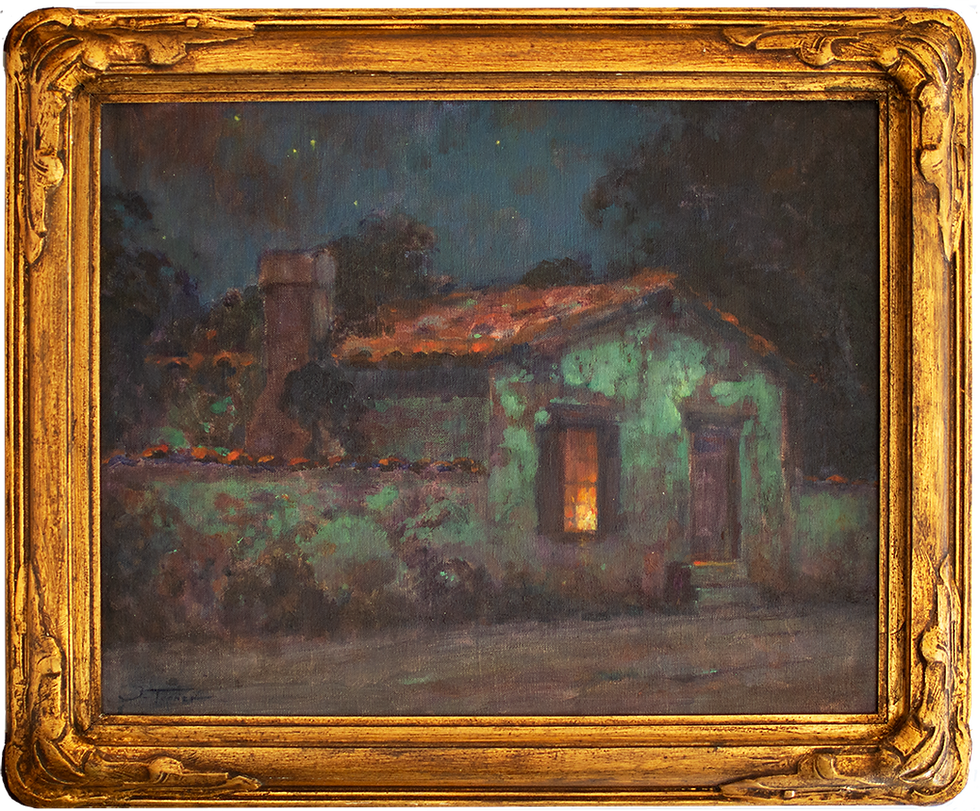
Sherman Quarters
Moons are obliged to labor hard in nocturne paintings.
Castro Adobe, Circa 1890
The sunset is now just a smudge of pale rose glowing on the horizon, only moments away from becoming a memory.
Circa 1800.
Little do we know about the Spanish soldier who built his adobe home on a rise above El Estero. It was some time in the late 1790s or early 1800s, following his many years of service in Alta California. Most Monterey adobes have had numerous owners, many whose names are undiscoverable today because documentation has been lost or never existed in the first place, but Antonio Mario Castro was probably the builder: records from 1836 show it was the home of one Maria Beltran, ‘widow of Antonio Mario Castro.’
Little do we know of him…but we can imagine:
Antonio followed tradition and built his home with the door facing eastward to take advantage of the warmth of the morning sun. His neighbors throughout Monterey had done the same. Standing on the other side of his home and looking westward toward Monterey's flatlands, he would have easily identified the town’s landmarks, none of them more than a mile or so distant.
He could have reached central Monterey in the lesser part of an hour, striding along at a normal clip, or somewhat longer after a hard rain, slogging through bogs and muddy pathways. He would have made the trip regularly to buy his beans, flour, vegetables and hot chili peppers, and perhaps a hare or some cow or pig or sheep meat to supplement the chickens pecking randomly in his yard. If he had a spare coin or two he might have visited a tamale parlor or tavern operating out of adobe buildings quite similar to his own.
He and Maria would have sought out the popular entertainments of the day: horse races and rodeos, stage plays, bailes (the two might dance the fandango to lively guitar accompaniment), and bull vs. grizzly fights if they had the stomach for that kind of thing. Certainly they enjoyed watching the antics of the resplendent, swaggering, horse-riding, cattle-ranching, senorita-serenading vaqueros and other denizens of Spanish descent who contributed so much to Monterey’s cultural heritage.
Two fingers of El Estero point south just a few yards down the hill from Antonio’s home, and a few steps beyond the lagoon waits San Carlos Cathedral. El Estero held edible fish and attracted game birds aplenty. Streams draining to the lagoon provided ample fresh water. An old soldier on a small pension could sustain himself here, and worship, and find enjoyment, but not necessarily thrive.
This small story about Antonio is not so much inauthentic, as educated speculation. We hope it illustrates a few essential truths about the spareness of life in Monterey, 1800.
As Mexican rule ended and the missions began to fail and crumble, the precious mission bells began to disappear, taken for use in other churches, taken by relic hunters, taken by local tribes for safekeeping, taken by whomever might find a use for them.
Many of them were re-discovered years and decades later, and returned to their original settings in our restored missions. Those deemed irretrievably lost were reproduced. When you hear bells calling from Monterey’s mission churches—Carmelo and San Antonio and Soledad and San Juan Bautista (once situated in Monterey County)—know that those calls may come from the original Spanish bells of 200 years ago and more.
Mission Church Courtyard,
Alta California
The bells are silent tonight, but come morning they will drive the demon.
California’s governing officials began mapping out counties soon after statehood was granted in 1850. Under Spanish and Mexican rule, counties as we understand them did not exist.
From 1850 to 1874 the church stood in the town of San Juan in Monterey County. Since 1874 it has been situated in the town of San Juan Bautista in San Benito County. The placement of the structure did not change—the county boundaries and town names did.
The Mission Church, Humbled
A gray owl calls out from its dark shelter.
This painting is based on a series of late-1800s photographs documenting the gradual disintegration of Carmel’s mission church. These photos constitute the best available record of the progression of decay. They are good photos for their time, the photographers well known, in their day and ours, for their competence. The sharp eyes and steady hands of those skilled lensmen captured an abundance of important detail, and by good fortune their photos passed down to our time.
Turner’s own steady hand and discerning eye have transformed the blacks, whites and grays of film into a mesmerizing painting that captures remnants of the church’s former dignity. Above the fallen blocks and rafters, above the weeds and other rubble, vestiges of Its elegant stone artistry remain. Its aura of permanence, though, is now just a ghostly memory.
Point Joe
“I saw the spars and planks of shipwreck on the rocks...”
Poet Robinson Jeffers
Celia
Celia was a wooden steam schooner built by renowned shipbuilder Matthew Turner at his shipyard in San Francisco bay in 1884. Those in the know say Matthew Turner never built a ship that was graceless, or balky, or leaked or was otherwise unseaworthy. Joaquin Turner’s painting depicts how she must have appeared in the darkest hours of her futile battle with rocks and weather, the fog having deceived her captain about her position with respect to Monterey Bay.
A Matthew Turner hand-built schooner should be remembered with reverence, but Point Joe and its Restless Sea did not permit Celia that honor. Point Joe gave her only a slow, moldering end: no titanic life-or-death struggle, no brave slide to a deep bottom, no romantic view of ragged sails flying as portrayed in the final frames of a classic silent film. No dignity in her last moments.
No, none of that. Point Joe’s maw held her mercilessly clamped in this relentless, Restless Sea where she wallowed, visible for years, hull caved, masts shattered, deck littered with battered spars and ragged rigging, Monterey’s granite slowly grinding her apart, piece by piece, for all to gawk at and pity—a tangled ruin.
Kittering: a midnight symphony of the combined yips, yelps, keens, barks, growls, and howls of a pack of excited coyotes.
(Sheppard’s Curious Dictionary of American Reverie)
This painting reacquaints us with the old-time farmsteads about which John Steinbeck wrote. One can still find remnants of them along rural back roads long since bypassed by modern highways. They are old and ramshackle and increasingly scarce. Turner has softened the ragged look of one of those places, muted the memory of dusty-dry valley heat from earlier in the day, and cast a peaceful mood over it all.
We feel a curious kind of nostalgia, a longing for a place in a time so long gone by we cannot have lived it. An impossible nostalgia, then, until we realize we are conjuring up times and places made familiar to us in Steinbeck’s gripping prose, Dorothea Lange’s emotionally moving photos, Woody Guthrie’s evocative lyrics, and the works of other great artists of their time.
One cannot travel long in inland Monterey County without gaining an appreciation of the varied landscape that speaks of a quintessentially “old California,” a way-back time when small adobe houses and large haciendas prevailed, when distance and rugged hills defeated ready access to the sere long valley east and the coastal coolness west. There were fewer green fields then. More cattle and sheep, though.
Monterey county’s inland valleys and coastal ranges are indescribably tranquil and soulful in their darker hours. In twilight and well into the moonlit darkness, we see everywhere the promise of nocturnes waiting to be painted.
The night is still and quiet, but for the soughing of the wind and kittering of the coyotes.
(Inspired by Woody Guthrie's great song)
Pastures of Plenty
Hand-carved detail from a carved and gilded
period frame